Buying Guides
Laboratory Temperature Monitoring: A Practical Guide
What to monitor in a laboratory — ultra-low freezers, 2–8 °C refrigerators, cold rooms and ambient. USB vs real-time loggers, alarm thresholds and audit-ready records.
A laboratory freezer fails at 2 a.m. Nobody is in the building. By morning, a rack of samples worth weeks of work has thawed — and the only record is a manual check sheet from the previous afternoon.
What would continuous laboratory temperature monitoring have changed?
It would have sent an alert while the failure was still recoverable, and it would have produced a complete temperature record for every storage point — automatically.
What to Monitor in a Laboratory
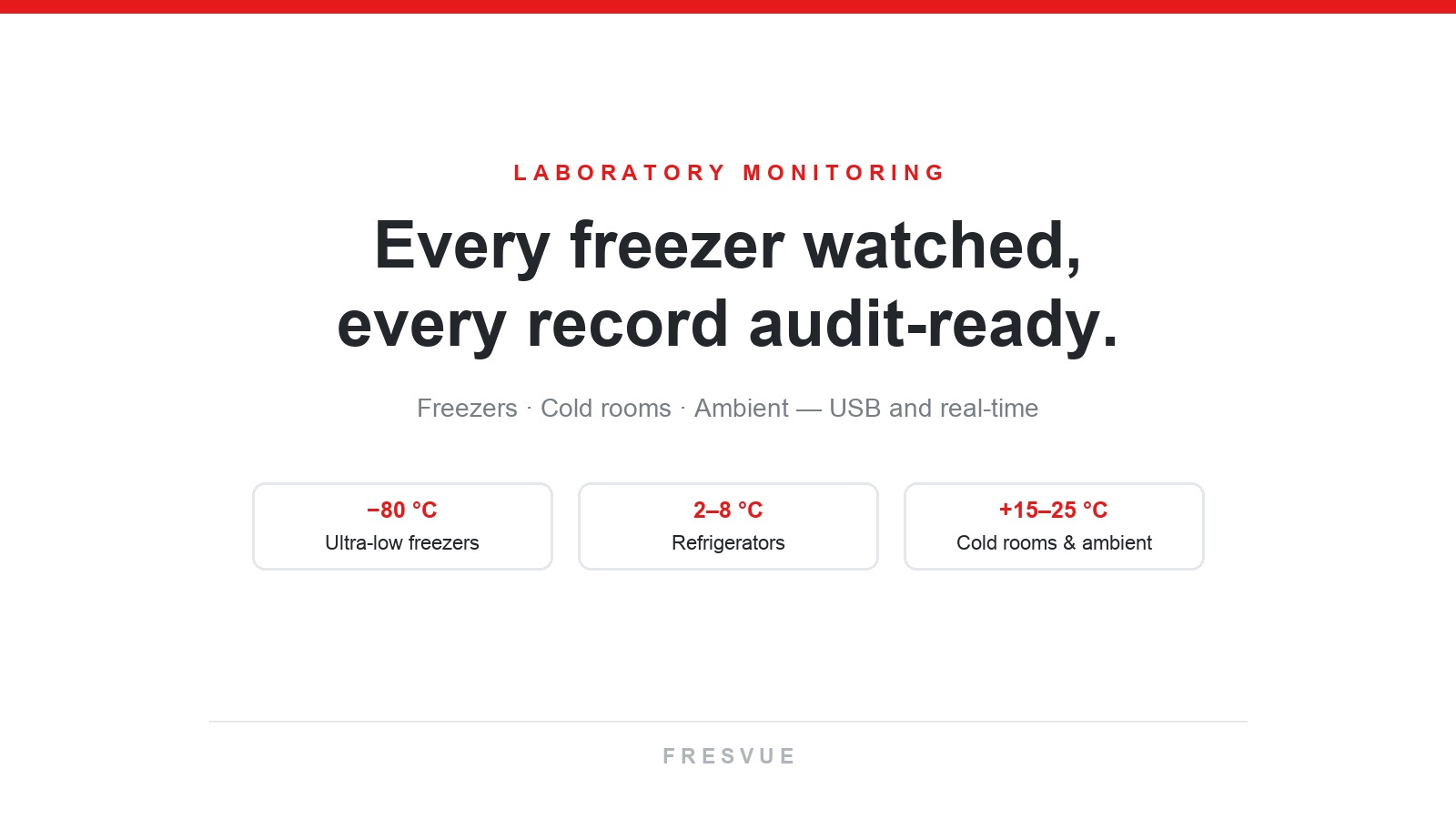
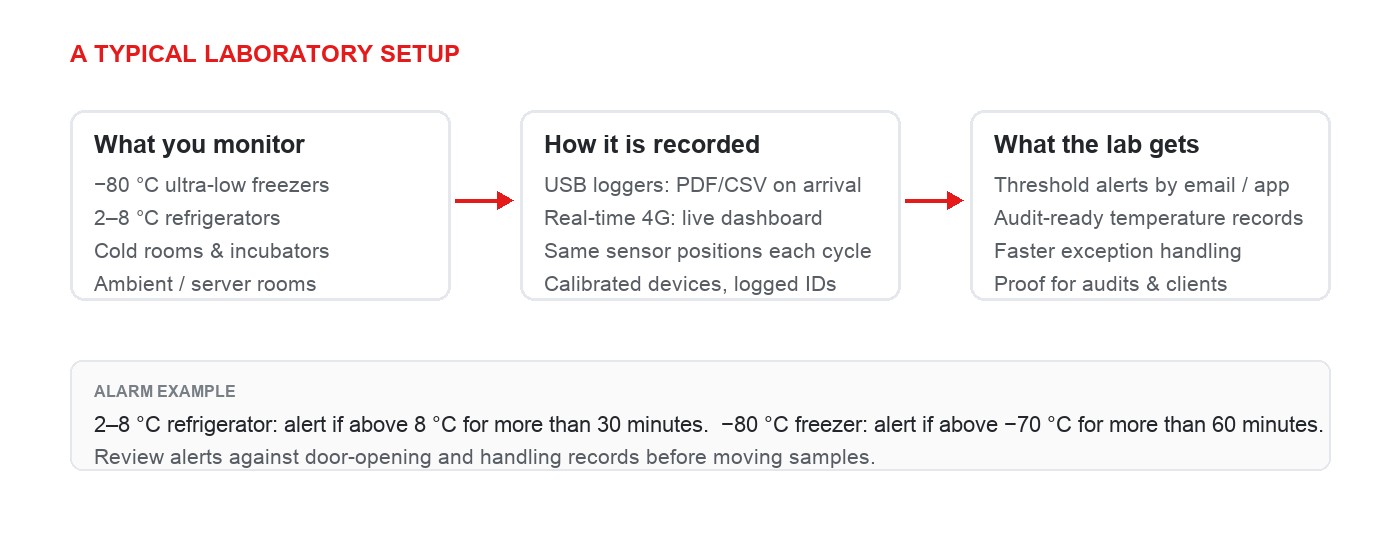
Most labs run four temperature zones at once. Ultra-low freezers hold samples at −80 °C. Laboratory refrigerators keep reagents and biologics at 2–8 °C. Cold rooms and incubators sit at their own setpoints. Ambient areas matter too, because room temperature affects chemicals and equipment calibration.
USB Loggers or Real-Time Monitoring?
USB temperature loggers are the simplest starting point. Place one in each freezer or cold room, download the PDF report once a week, and file it. They cost little and need no infrastructure.
Real-time monitoring adds what USB cannot do: alerts while an excursion is happening. A 4G logger in the laboratory uploads temperature and humidity readings to the cloud and pushes threshold alarms to email or an app — useful overnight, on weekends, and for high-value sample collections.
Many laboratories run both: real-time units on the most critical freezers, USB loggers everywhere else.
Alarm Thresholds and Intervals
Set alarms against the storage requirement, not the device display. A 2–8 °C refrigerator should alert if it rises above 8 °C for more than 30 minutes. An ultra-low freezer should alert above −70 °C for more than 60 minutes. Short thresholds filter out door-opening noise; long thresholds miss real failures.
Records That Survive an Audit
Auditors ask for three things: complete records, known sensor positions, and calibrated devices. Keep logger IDs in a placement plan, download or stream data on a fixed schedule, and keep calibration certificates with the logger serial numbers. For labs shipping samples, the same records also protect sample quality in transit — see our guides on monitoring laboratory freezers remotely and lab and warehouse temperature monitoring.
Recommended Logger for Laboratories
The FRESVUE ZLOG-20GTH-LI Reusable Real-Time Temperature & Humidity Data Logger covers −30 to +60 °C with humidity, uploads over 4G where coverage exists, and recharges via Type-C between cycles. For labs that only need periodic PDF reports, the single-use USB range starts at the ZTAG series.
Planning monitoring for a laboratory or sample store? Contact FRESVUE — tell us the storage points and temperature ranges and we will suggest a setup within one business day.