Buying Guides
Real-Time vs USB Data Loggers: The Cost Comparison Most Shippers Get Wrong
USB loggers cost less per shipment; real-time loggers prevent losses a USB logger can never see. A working comparison by lane length, cargo value and dispute risk — with the year-one math most buyers
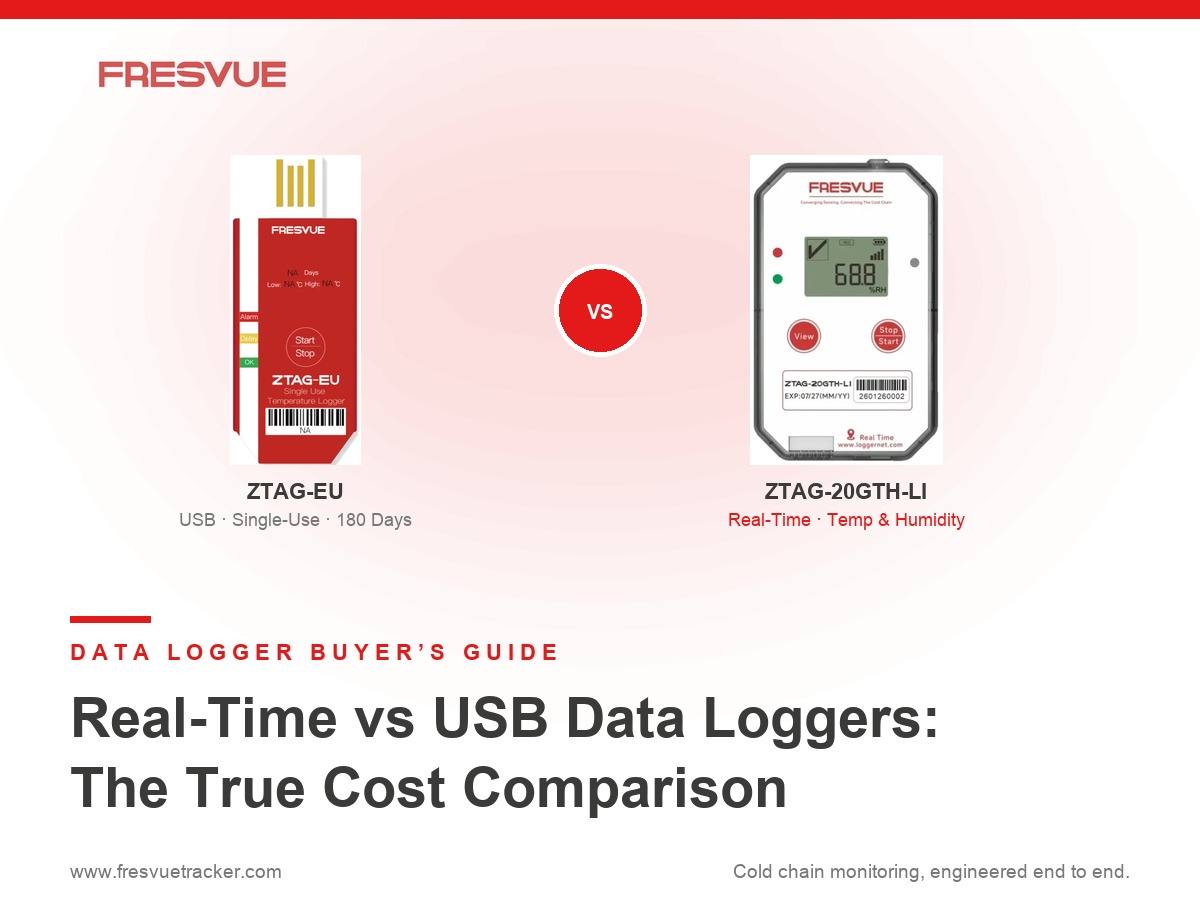
Both devices record temperature. Both produce a report. On a spec sheet they can look almost interchangeable — and that is exactly where the expensive mistake happens. The real difference between a USB data logger and a real-time data logger is not on the datasheet. It shows up in three places: when you learn about a problem, what you can prove afterwards, and what the whole setup actually costs over a year of shipments.
How Each One Works in Practice
A USB logger is the simpler ritual: activate it, place it in the cargo, close the container, and forget about it until arrival. At the destination, someone plugs it into a computer and a PDF report comes out. One device, one journey, one file. Nothing to charge, no subscription, no network dependency — the ZTAG-EU single-use USB logger, for example, records for up to 180 days on an internal battery and plugs directly into any computer at the end of it.
A real-time logger starts the same way but never goes quiet. From the moment the container closes, it measures and transmits over 4G whenever a network is reachable — at the port, along coastlines, at transshipment hubs. Between signals it keeps recording locally and uploads automatically later, so the timeline has no holes. You see the journey as it happens, and if temperature crosses the band you set, an alert reaches your email and phone while there is still time to do something about it.
The Moment They Diverge: Day 9 of a 22-Day Voyage
Imagine a reefer container whose setpoint was entered wrong at stuffing. With a USB logger, that error lives undetected for the rest of the voyage. The report is read at the port of discharge — twenty-two days after the doors closed — and by then the fruit has either made it by luck or it has not. The logger becomes a forensic tool: useful for the claim, useless for the cargo.
With a real-time logger, the same error surfaces on day nine as an alert on a phone. The exporter calls the shipping line, the setpoint gets corrected at the next port call, and the fruit arrives. Nobody files a claim because there is nothing to claim for. This — not the spec sheet — is the entire product difference: a USB logger documents a loss, a real-time logger interrupts one.
The Year-One Math Most Buyers Skip
Per unit, USB wins on price — that is real, and it is why USB remains the right tool for plenty of lanes. But the per-unit price is not the cost that matters. The honest comparison looks like this:
USB, per shipment — a low device cost, plus the labour of retrieving and reading each unit, plus the blind spot in the middle, plus exposure to the full value of any undetected excursion. On a container of bananas or flowers, that exposure is routinely tens of thousands of dollars.
Real-time, per shipment — a higher device cost for single-use units (or a reusable device amortised across its service life), plus a subscription or platform cost, and in exchange: bounded losses, fewer disputes, and the ability to warn the receiving side before the cargo lands. One prevented excursion — one container that does not have to be rejected — usually covers the monitoring cost of the entire year.
The buyers who get this wrong are not the ones who chose USB. They are the ones who chose USB for a lane where the cargo value and the dispute history made real-time obvious — because they compared purchase prices instead of comparing outcomes.
Five Questions That Decide It for Your Lane
How long is the voyage? Under three days, an excursion you discover on arrival has cost you little time to react anyway. Over two weeks, discovery delay is the single biggest risk — and this is where real-time earns its keep.
What is the cargo worth per container? The monitoring budget should scale with the exposure it protects — a few hundred dollars of logger against tens of thousands of dollars of fruit, pharma or samples is not a hard trade.
How often do disputes happen on this lane? If every damaged arrival turns into a negotiation, the timestamped, geolocated record from a real-time logger is the cheapest lawyer you will ever hire.
Can the unit come back? Single-use USB loggers assume someone retrieves them. On lanes where the unit never returns, single-use real-time (placed and abandoned) or long-life USB designed for the trip removes the recovery problem entirely.
What do the auditors ask for? GDP and retail QA programmes increasingly expect continuous, gap-free records with alert evidence — a bar that periodic USB downloads struggles to clear.
Where USB Still Wins — Honestly
This is not a case for real-time everywhere. Short trucking lanes, domestic moves, low-value ambient cargo, and shipments where the importer only needs an arrival record are exactly where a USB logger is the correct, economical answer. ZTAG-EU covers those lanes with up to 180 days of recording and a one-plug report — no connectivity, no platform, no complexity. Choosing it there is not a compromise; it is the right sizing.
Where Real-Time Is No Longer Optional
Long ocean lanes with high-value perishables. Pharmaceutical shipments under GDP. Lanes with a dispute history. Any cargo where a single undetected excursion costs more than a year of monitoring. For these, the choice is between two real-time form factors: the ZTAG-20GTH-LI single-use real-time logger for shipments where the unit will not come back, and the reusable ZLOG-20GTH-LI for storage rooms and repeat lanes — one device protecting cargo continuously across a two-year service life.
The Hybrid Setup Most Shippers Land On
After running the numbers, most exporters and logistics providers end up not with one technology but with a policy: real-time monitoring on the lanes and cargo where blindness is expensive, USB logging on the lanes where it is not — and a single reporting standard across both, so every shipment file looks the same to the customer and the auditor. If you want help mapping that policy across your lanes, contact FRESVUE with your routes and cargo profile — we will recommend the configuration lane by lane, and you can decide with the math in front of you.