Buying Guides
Dry Ice at -78.5°C: How to Prove Your Shipment Stayed Frozen
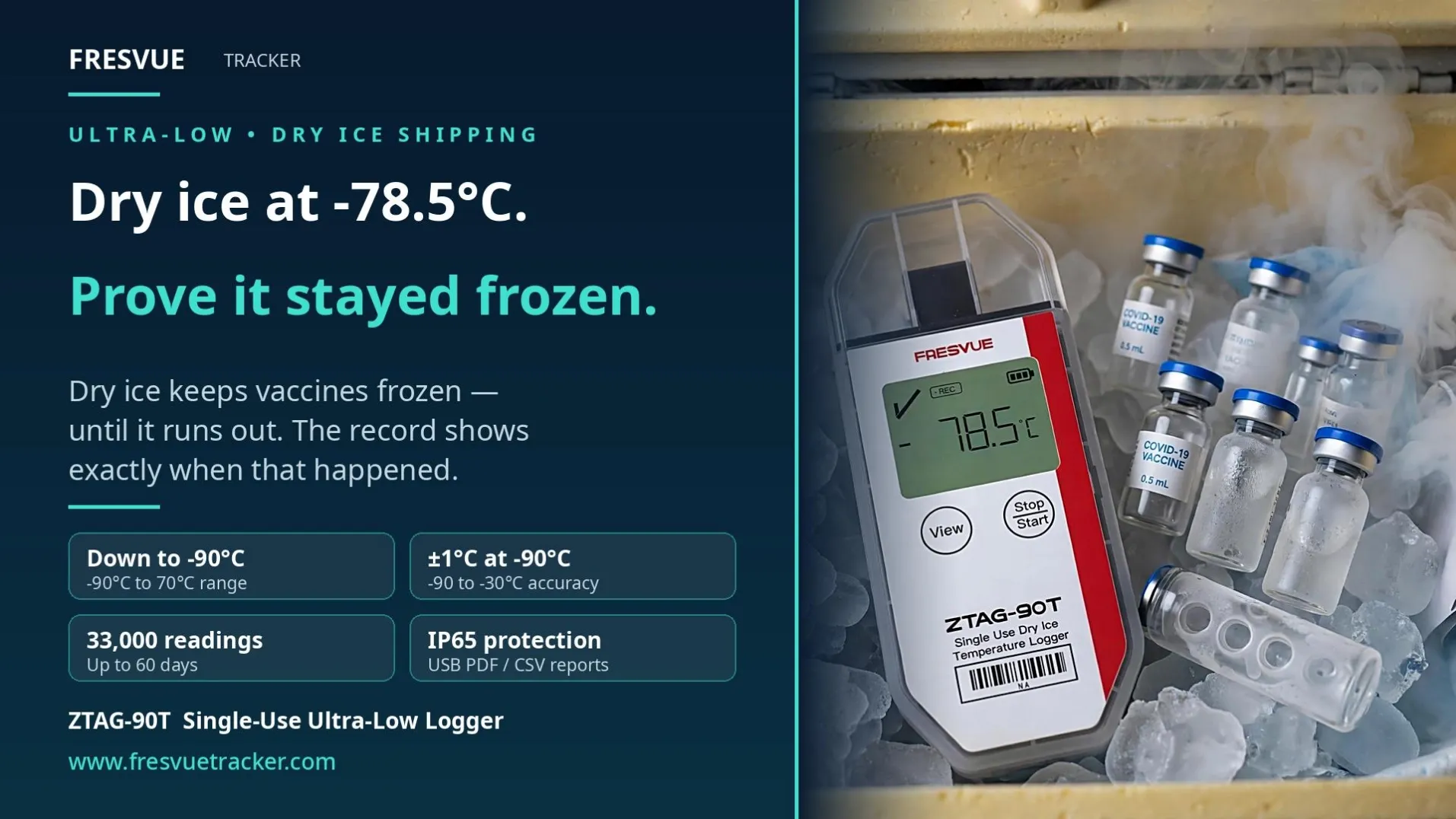
Dry ice keeps vaccines frozen at -78.5°C — until it runs out. An ordinary logger cannot even measure that cold. Here is what proof looks like at -78.5°C, and the logger built for it.
Your shipment of vaccines leaves on dry ice. It arrives three days later, the box is light, and the receiver asks one question: can you prove it stayed frozen the whole way?
Dry ice does not melt. It sublimates — solid carbon dioxide turning straight into gas at -78.5°C. While dry ice remains, the box stays at -78.5°C. When it runs out, the temperature climbs, fast. The temperature curve tells the whole story: flat at -78.5°C means the dry ice lasted; a climb means it ran out, and when.
But only if someone was measuring it. And most loggers cannot.
Why ordinary loggers fail at -78.5°C
A standard temperature logger measures down to -20°C, or -30°C, or -40°C at best. Put it in a dry-ice box and it does one of two things: it flatlines at its lowest reading, or it stops recording altogether. Either way, the record shows a gap exactly where the proof should be — and a gap is not evidence.
The receiver cannot tell whether the product stayed at -78.5°C or warmed to -30°C on day two. Neither can you. The shipment is a loss, even if the product was never at risk.
What proof looks like at -78.5°C
The same rules apply as for a 2–8°C vaccine shipment, only colder. Auditors and receivers want a continuous record, not one reading at arrival; the full curve, with timestamps; the alarm history — when it crossed a threshold, for how long; a report that cannot be edited after the fact; and calibration and identity — which logger, which shipment, which calibration.
At -78.5°C, there is one extra requirement: the logger has to actually work there. A record that stops at -40°C proves nothing about the coldest, most important part of the trip.
The logger built for dry ice
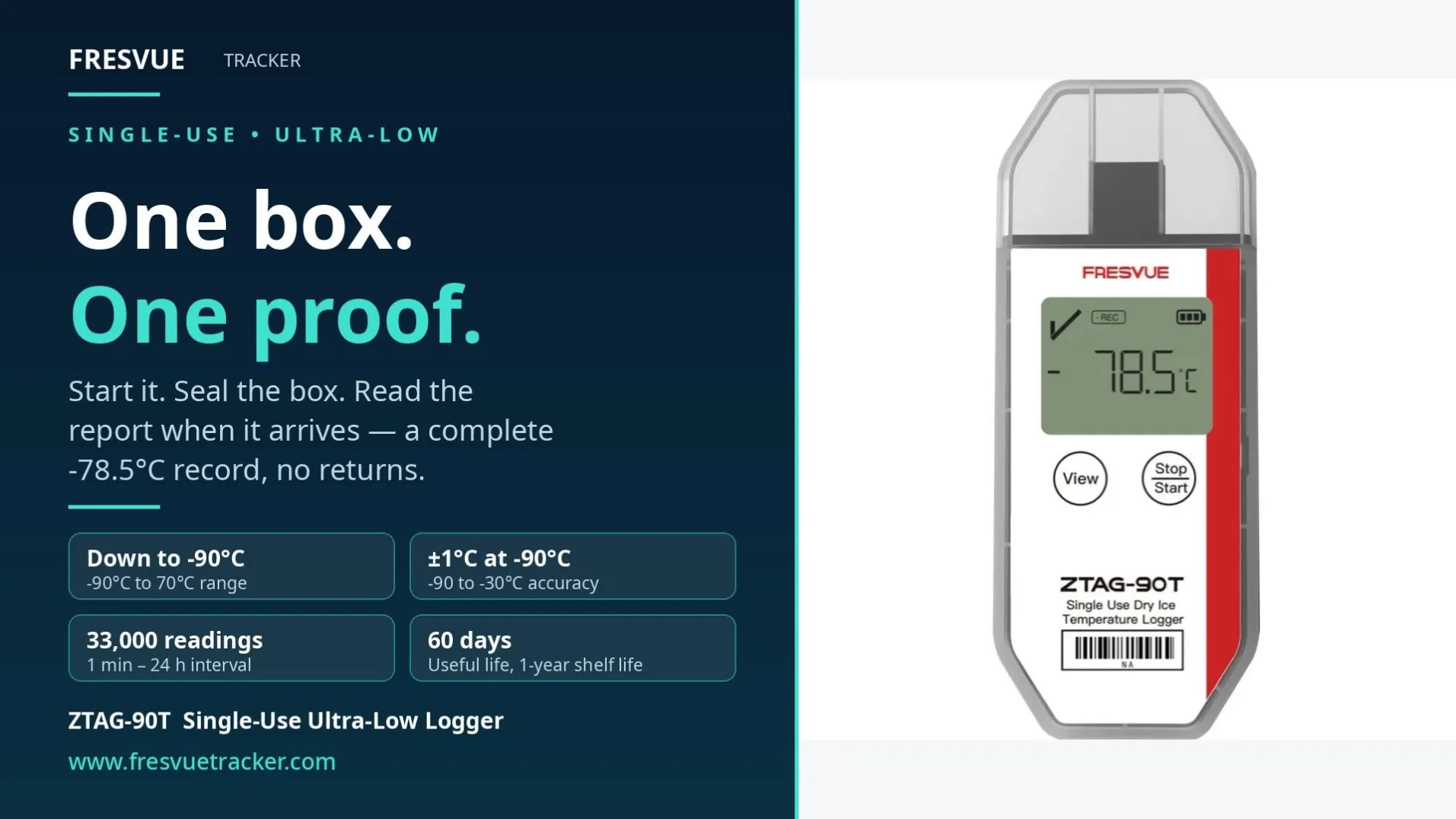
The ZTAG-90T is a single-use ultra-low logger made for exactly this job. Range -90°C to 70°C, so -78.5°C sits comfortably inside it, not at its edge. Accuracy ±1°C at -90 to -30°C. Memory for 33,000 readings, logging every 1 minute to 24 hours, with up to 4 alarm limits. IP65, USB 2.0, and a PDF/CSV report straight from the logger. Sixty days of useful life, one-year shelf life.
Start it, place it in the insulated box beside the product — not buried in the dry ice itself, where it would read colder than the vaccines beside it — and seal the box. When the shipment arrives, plug it in and read the report. No receivers, no software to install, no returns.
At receiving, check three things
Download the PDF before opening the box. Check the full curve, not just the last reading: was it flat at -78.5°C, and if it climbed, when did it start? Match the climb to the handover times — a rise during a transfer tells a different story from a rise on day three, when the dry ice was simply spent. Note the logger ID and shipment number on the report.
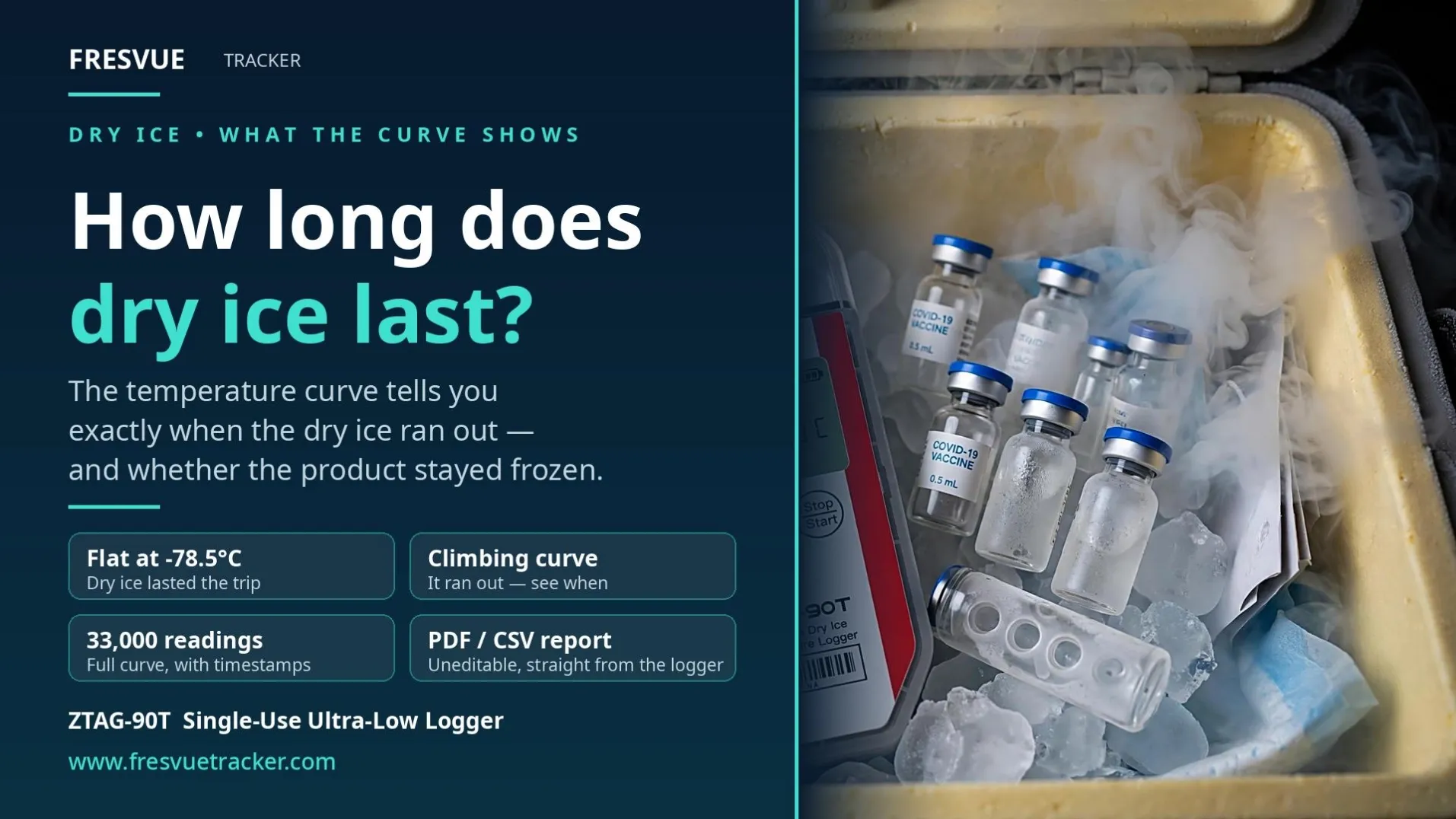
A dry-ice shipment is not proved frozen by arriving cold. It is proved by a record that covers the whole trip at -78.5°C and cannot be rewritten afterwards. Build that record into the box, and a light box stops being a surprise.