Expand Your Data Logger Range Without Increasing Development Costs
Your customers now ask for live 4G proof and ultra-low monitoring. Building those loggers yourself would take years and a development budget. Adding a proven, white-labelled range costs neither.
Every distributor reaches the same point. Your customers start asking for something your range does not have yet — and the choice looks like this: build it, buy a range in, or watch the order go to someone else.
Building it is the expensive option. A real-time logger is not one product: hardware, firmware, cloud, alarms, PDF reports, certification and calibration — years of development before the first sale.
There is a faster way to expand a range: add loggers that already exist, already work, and already sell in 60+ countries — under your own brand.
The gap your customers are asking about
Look at a typical distributor range today. USB loggers are reliable and cheap, but the data only appears when the shipment arrives — too late to save it. Bluetooth works within 30 metres, not on a truck halfway across the country.
What customers now ask for, in food and pharma alike, is proof while the shipment is still moving: live temperature and humidity, a location, an alarm the moment a threshold is crossed, and a report that cannot be edited after the fact. And for dry ice and ultra-low pharma, monitoring down to -90°C.
A full range, not one product
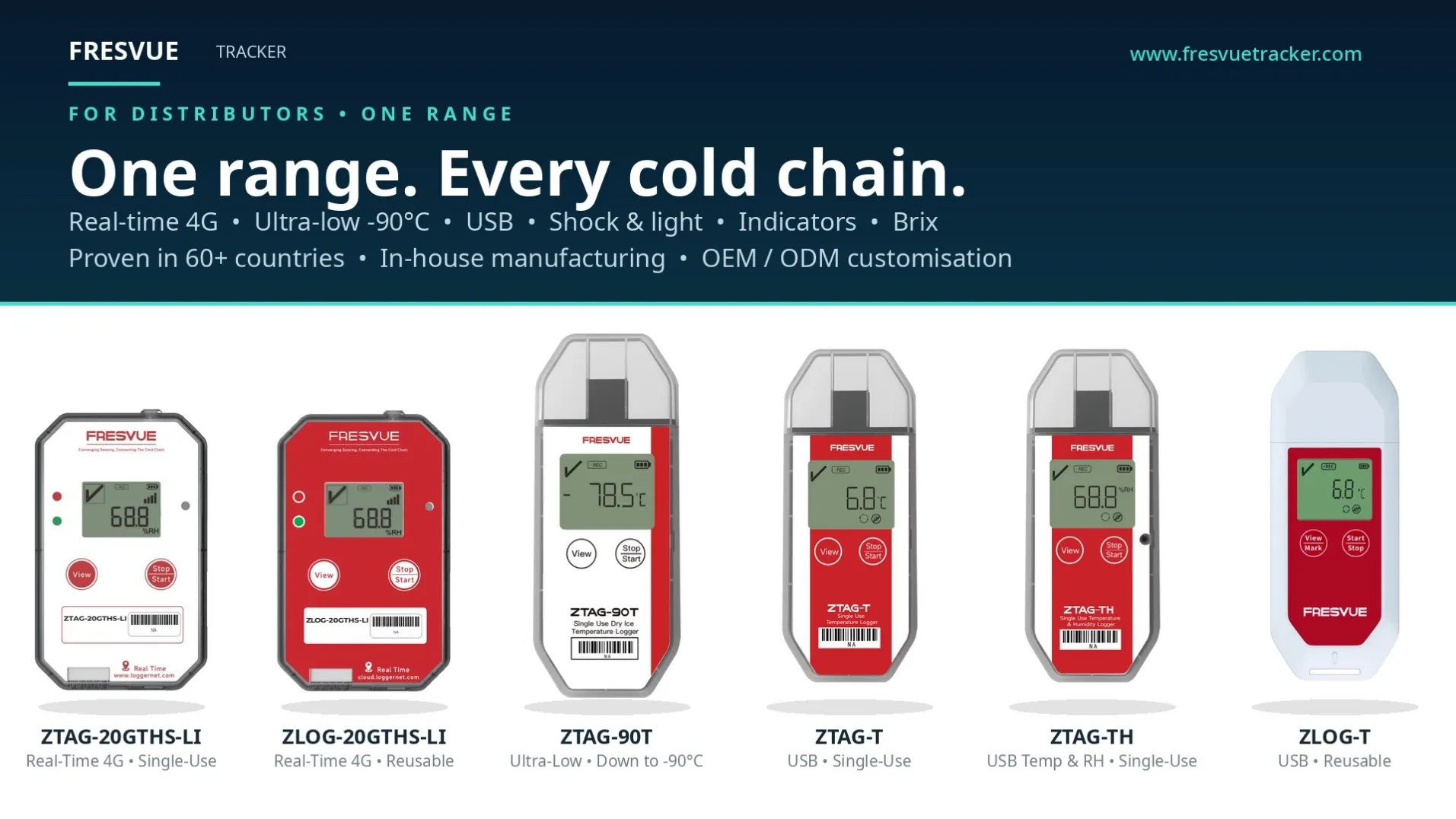
One order, one relationship, and every gap your customers ask about is already covered:
- Real-time 4G loggers — single-use ZTAG-20GTHS-LI and reusable ZLOG-20GTHS-LI. Live temperature, humidity and location over global 4G Cat.1, with email and app alerts and cloud PDF reports. Range -20°C to 70°C, accuracy ±0.5°C, 33,000 readings, IP64.
- Ultra-low loggers — ZTAG-90T, down to -90°C, for dry-ice shipments and ultra-low pharma.
- USB loggers, single-use and multi-use — from the ZTAG and ZLOGPRO families.
- Shock and light loggers — ZTAG-TS/TL, for shipments where temperature alone does not explain the damage.
- Temperature indicators — ZTAG-D/E, for a simple go/no-go check at receiving.
- A digital Brix meter — ZM-BR, for the fresh-produce customers already buying from you.
Food, pharma, life sciences, chemicals — one range covers the customers you already have, and the ones you are turning away.
Proven in 60+ countries
A new range is a risk if nobody has used it before. This one has: FRESVUE loggers already sell in more than 60 countries, in food and pharma supply chains that run every day. When your customer asks whether a logger works, the answer is not a datasheet promise. It is a track record.
Capacity to deliver
A range is only useful if it is there when the order lands. As the manufacturer, FRESVUE produces in-house in Shenzhen, with the capacity to scale from trial orders to full container loads — so a distributor never has to turn a big order away for lack of stock.
Flexible customisation
Every market is different, and a fixed product rarely fits all of them. The range is built to be customised, not just rebranded:
- Your brand — logo on the logger and the packaging.
- Your configuration — alarm thresholds, recording intervals, report format, to your specification.
- Your calibration — calibrated to your own points, so the certificate your customer receives carries your name.
- Your support — in your time zone, in your customers' language, backed by the manufacturer.
OEM/ODM is not a side service here. It is how the range is sold.
How it works in practice
It does not need a year-long project. Pick the models that fill your gaps, white-label them, calibrate them to your own points, and sell them to the customers already asking for live proof and -90°C. First shipments in weeks, not years.
The bottom line
Expanding a data logger range does not have to mean expanding a development budget. The expensive work is already done, the range is already wide, and the capacity is already there. What is left is what distributors are already good at: choosing the right products, putting their name on them, and standing behind them.
Related reading: Single-Use vs Reusable Temperature Data Loggers: How to Choose for Your Cold Chain
Vaccine Shipment Rejected? How to Prove Your 2–8°C Cold Chain Never Broke