Buying Guides
Temperature Indicators: Instant Proof at the Receiving Dock
No cables, no software, no 20-page report to read. A temperature indicator shows OK or ALARM at a single glance — instant proof at the receiving dock. How they work, where they beat data loggers, and
Two hundred boxes arrive at a receiving dock. Before accepting them, the consignee wants one question answered in one glance: was the cold chain intact? Plugging a data logger into a laptop and reading a PDF report for every box is not going to happen. A temperature indicator answers the question in about two seconds — a small window on the box shows OK, or it shows ALARM. That instant, visual, at-the-dock proof is the entire reason temperature indicators exist.
What a Temperature Indicator Is
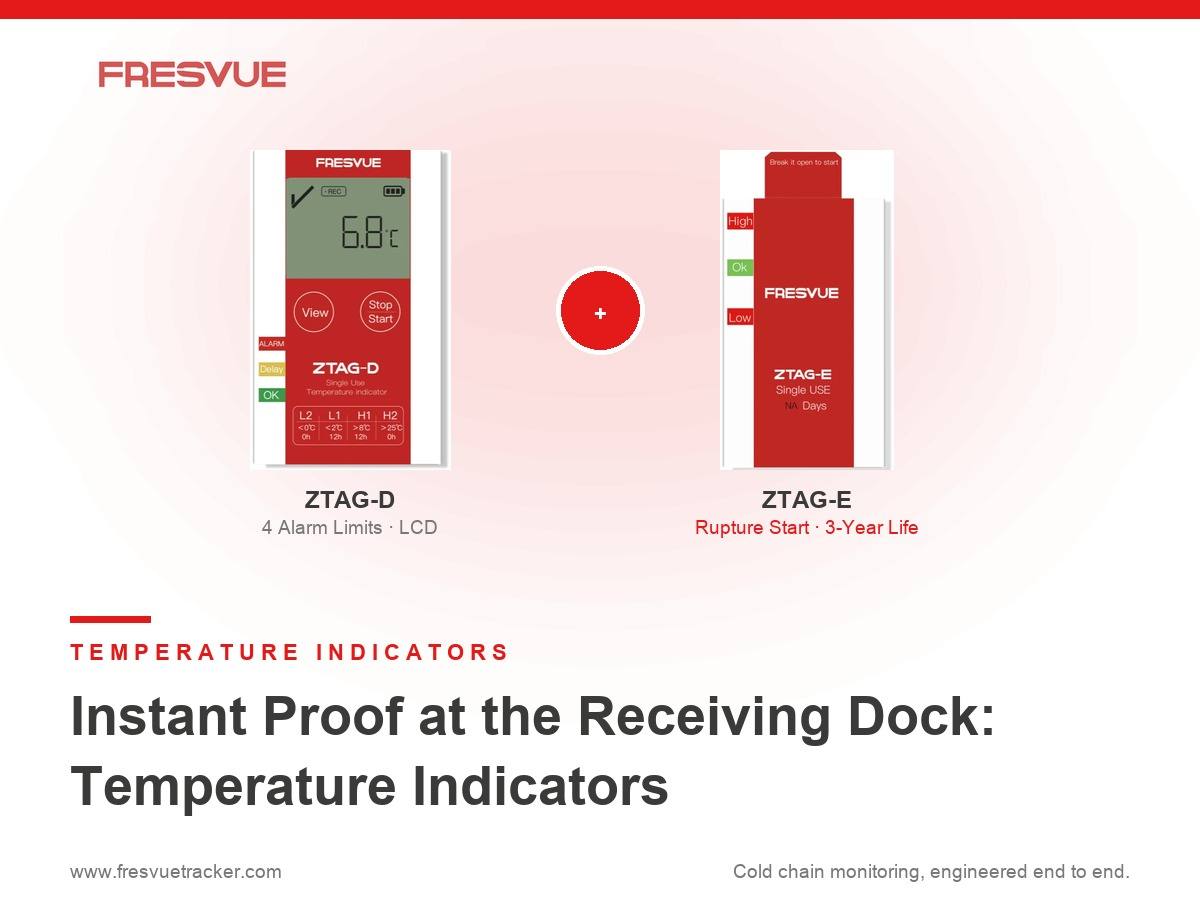
A temperature indicator is a single-use device that shows — visually, with no training and no software — whether a shipment stayed within its temperature limits. It does not produce a journey report. It produces a verdict: OK or ALARM, right on the device, visible to anyone holding the box. Two models cover most needs:
The ZTAG-D temperature indicator has an LCD with four configurable alarm limits — for example L2 below 0°C for 0 hours, L1 below 2°C for 12 hours, H1 above 8°C for 12 hours and H2 above 25°C for 0 hours — plus ALARM, Delay and OK status lights. It starts with a button, so timing is controlled at packing.
The ZTAG-E temperature indicator starts by breaking a strip — zero buttons, zero training, nothing to forget. It shows High, OK or Low marks for instant visual verification at delivery, runs up to 2 configurable alarms, keeps a 3-year shelf life, weighs 5.7 g and is waterproof to IP67.
Where Indicators Beat Data Loggers
Receiving and last mile. When the handoff matters more than the history — a pharmacy accepting a vaccine delivery, a distributor checking a fruit pallet, a clinic receiving a shipping box — the indicator turns a procedure into a glance. No cables, no retrieval, no data step, no software on the receiver's computer.
Low-administration shipments. Indicators need no return logistics: the unit stays with the box. They stock and travel like labels — activate, apply, ship. And because models like the ZTAG-E keep a 3-year shelf life, you can hold a ready supply on the shelf the way you hold packaging materials.
Visual proof for the receiver. In many markets and many relationships, the receiver does not want a data file — they want to see status with their own eyes before signing. An indicator turns trust into something visible.
Where You Still Need a Logger
An indicator gives a verdict, not a journey. It cannot show you when the excursion happened, how long it lasted, or where. It cannot alert anyone mid-shipment. And for GDP programmes, audits and insurance claims, a yes/no at the end is not evidence — a continuous, timestamped record is. Those jobs belong to data loggers: single-use USB loggers when you need the arrival report, real-time loggers when you need to act during the voyage. Our real-time vs USB cost comparison walks through that choice in detail.
The Three Options at a Glance
Temperature indicator — a visual verdict at delivery. Learns nothing in transit, proves everything at the door. Lowest cost, zero administration.
USB data logger — a complete journey record, read on arrival. Proves what happened and when; discovers problems only after they are over.
Real-time logger — the full journey plus live alerts while it is still possible to act. The premium option for high-value and compliance-critical cargo.
Why Many Shipments Carry Both
In pharmaceutical last mile and export fruit, the two tools work side by side: an indicator on the outside of the box settles the handshake at delivery, while a logger inside keeps the complete record that settles any later dispute. The indicator answers the receiver; the logger answers the auditor. Different jobs, one shipment — and together they close both the operational and the evidential gaps.
How to Choose Your Indicator
Alarm structure — if your product has one simple limit, a High/OK/Low indicator is enough; if it has a complex profile (freeze risk plus heat limits plus cumulative exposure), the ZTAG-D's four time-weighted limits map directly to real stability requirements.
Start method — rupture-start (ZTAG-E) removes a step and cannot be started late; button-start (ZTAG-D) gives you controlled timing when packing happens hours before dispatch.
Environment and life — check waterproofing (both models are IP67), shelf life (up to 3 years) and weight when the indicator travels on small retail boxes.
Tell Us What Has to Survive the Trip
Every lane and every product combines these tools differently. Send FRESVUE your route, your product and — most importantly — who needs to see the data at delivery, and we will configure the right indicator, the right logger, or the right mix of both. Explore the ZTAG-D temperature indicator and the ZTAG-E temperature indicator, or contact us for the full catalog and a one-on-one consultation.